




 Chicken Road 2
Navigate Six Traffic Lanes. Avoid Oncoming Vehicles. Stack Multipliers to 1.19× Each Row

Demo access – no registration required – payment details unnecessary
Both games share the core crossing mechanism: advance lane by lane, withdraw winnings whenever you choose, and select from four challenge tiers spanning 30 lanes down to 18. The visual design differs between releases. Test each in practice mode to find your preference.
Try Chicken Road insteadMinimal danger zone with lowest exposure. Ideal for slowly accumulating multiplier value without aggressive risk.
Modest multiplier increase. Vehicle density stays comfortable for consistent advancement.
Intermediate zone balancing safety against reward. Moderate danger for reasonable multiplier growth.
Enhanced payout territory. Traffic frequency rises but multiplier growth accelerates noticeably.
High-risk area with major multiplier jump. Demands careful timing and composure under pressure.
Top multiplier row. Greatest hazard with turquoise vehicles showing up regularly. Peak difficulty challenge.
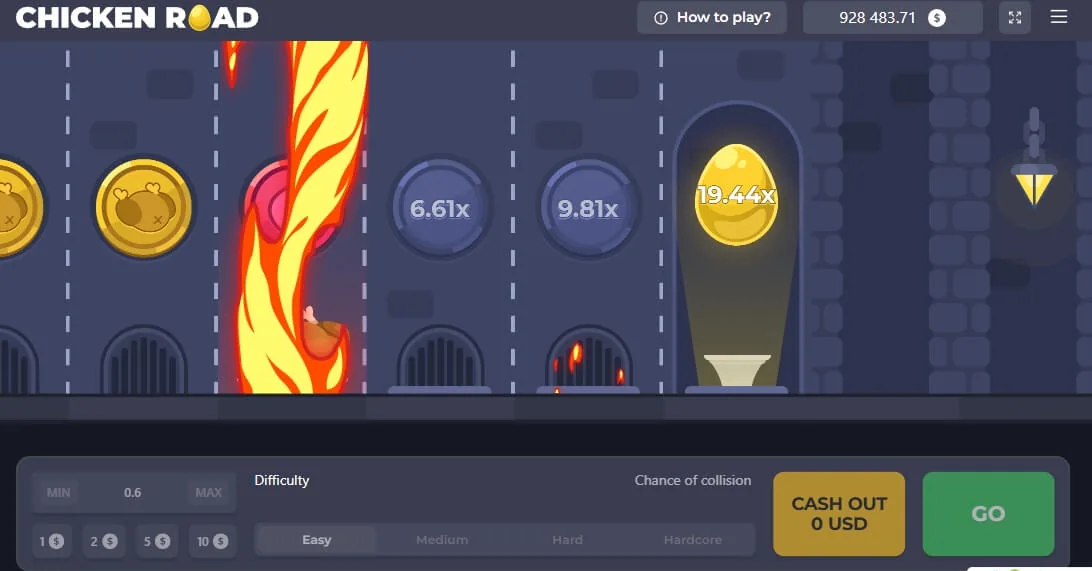
InOut's Chicken Road 2 discards conventional slot frameworks entirely, replacing them with stark choice-based pressure. Your white hen avatar occupies grey square paving at the kerb. Six asphalt strips lie ahead, each delineated by white broken centre lines and round drains showing multiplier figures.
Each completed lane adds its multiplier figure to your running total. Clear Lane 1 without incident and your stake grows by 1.01×. Progress to Lane 2 and you accumulate another 1.03×. These values build cumulatively with every safe advance, but the crucial factor: you may withdraw after any successful crossing. Hesitate too long and a turquoise vehicle terminates your attempt immediately.
The four challenge options don't merely tweak vehicle velocity. They radically change how many road strips you're allowed to cross before the round concludes. Easy mode allows 30 possible advances. Medium cuts this to 25. Hard permits just 22 attempts. Hardcore mode restricts you to 18 lines maximum. This establishes a mathematical upper limit on achievable multiplier that shifts enormously across challenge tiers.
Every lane holds a round drain with concentric rings and spoke patterns cut into dark grey steel. These aren't cosmetic flourishes. They're your multiplier markers. White numerals show the precise multiplier: 1.01×, 1.03×, 1.06×, 1.10×, 1.15×, and 1.19× for rows one through six. Row 6 gets partially clipped at the viewport boundary, heightening visual stress during the riskiest advance.
The interface delivers constant data. Top left corner displays the most recent player's outcome: profile picture, shortened username such as "Pink Witten...", and their profit in green digits prefixed with a plus. The credit readout uses a gold-orange gradient coin icon bearing the numeral 8, paired with brown typeface. Current player count reads 23,277 with a blinking green indicator confirming live status.
No win lines present. No bonus symbols. No complimentary spin rounds. Chicken Road 2 functions on raw probability and player withdrawal timing. You dictate when to collect, which lane to tackle next, and how boldly to chase multiplier growth. The hen's gentle bobbing animation creates misleading tranquillity before each crossing choice.
The launch area shows vertical-brushed grass in deep green along top and bottom edges, divided by grey paving slabs with visible joint lines. A narrow dark kerb edge defines the threshold where tarmac starts. These scenic components aren't arbitrary. They mark the secure zone visually, rendering the instant you tread onto black road surface psychologically weighty.
The software operates at 1920×1080 viewport dimensions within browsers, requiring no file downloads. Interface panel appears beneath the playing field featuring round stake selectors, four challenge switches, and a bold green "Play" command with rounded edges and drop shadow. Medium challenge activates as default with paler backdrop and white lettering, whilst dormant choices show in deeper grey.
Activate "Space to spin & go" within settings and keyboard input supplants mouse interaction. This accelerates crossing choices considerably but simultaneously raises accidental input danger during tense sequences when several lanes have been successfully traversed.
The £20,000 maximum payout threshold means that even with flawless Hardcore completion, stake amount governs whether you reach the cap. A £200 peak wager combined with theoretical optimal multiplier sequence might approach this boundary, though the 18-strip constraint on Hardcore renders this mathematically demanding.
This title favours pattern observation and probability judgement above mere chance. Monitor traffic behaviour across multiple rounds before committing funds. Record vehicle spawn rates at various challenge settings. The turquoise car in row 6 isn't merely aesthetic choice; it's the designated hazard terminating your most valuable crossing sequences.
An HTML5 build: everything happens in your browser tab, with zero files to fetch and no separate application needed. Display adjusts to your viewport dimensions.
The practice version mirrors the paid release exactly: identical challenge modes, identical multiplier values, identical user interface.